


 Nora Huin


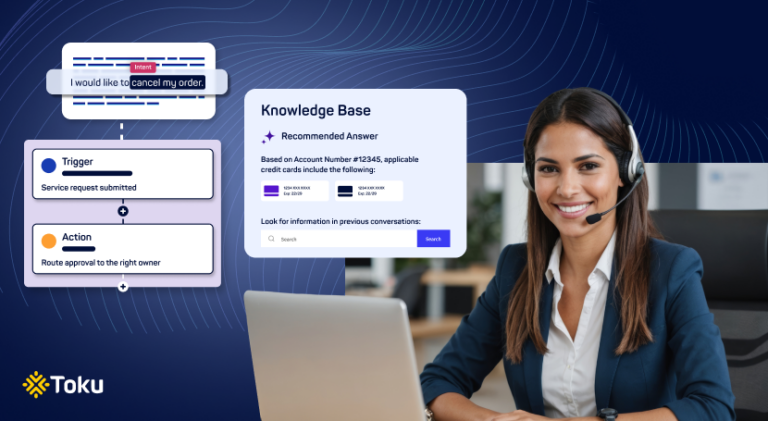

Discover the immense potential of AI-enhanced customer experience, and learn why leveraging proprietary data for CX and insights is critical for success.
An AI-powered contact centre uses artificial intelligence to automate routine service tasks, assist agents in real time, and turn conversation data into operational insight. It connects voice, chat, and digital channels under a single intelligent layer, helping customers get faster answers, agents work with better context, and leaders make more informed decisions about service performance.
Contact centres are under pressure from every direction. Customers want faster answers, agents need better tools, and leaders are expected to improve service quality without adding unnecessary complexity.
For many organisations, AI is becoming part of that answer. But an AI-powered contact centre is not simply a chatbot attached to an existing support operation. It is a more connected service environment where automation, analytics, and human support work together across the customer journey.
Why are AI-powered contact centres gaining attention from CX leaders?
AI adoption is already widespread, with BCG’s 2025 AI at Work survey finding that 78% of employees in Asia Pacific use AI at work at least weekly. As AI becomes part of everyday workflows, expectations for faster, smarter, and more connected service experiences are rising too.
For customers, this means service teams are now expected to recognise context, respond quickly, and provide smooth support across channels. For contact centres, the pressure is growing on multiple fronts: higher interaction volumes, more complex enquiries, and the constant need to manage costs without compromising service quality.
AI-powered contact centre solutions help address this by reducing repetitive work, improving routing, supporting agents during live interactions, and analysing conversations at scale. With the right AI capabilities in place, organisations can better understand what customers need, identify where service operations can improve, and deliver more consistent experiences across every interaction.
What makes a contact centre AI-powered?
A contact centre becomes AI-powered when intelligence is embedded across the service journey, not only at the point of self-service. AI can support conversations before they reach an agent, during the live interaction, and after the case has been closed.
Common capabilities include intent detection, intelligent call routing, voice and chat automation, real-time agent assistance, sentiment analysis, conversation summarisation, quality monitoring, and analytics across voice and digital channels.
How does AI improve the customer experience in a contact centre?
For customers, AI can reduce friction by identifying intent quickly, answering common enquiries, providing proactive updates, and avoiding unnecessary transfers. When a customer needs human help, AI can carry context into the handoff so the agent starts with a clearer picture of the issue.
This matters because poor handoffs are one of the most common causes of customer frustration. Customers do not want to repeat their problem across multiple channels or teams. AI omnichannel communications help maintain continuity from one touchpoint to the next.
How does AI support contact centre agents during live interactions?
AI is especially useful when it reduces the effort required to resolve an issue. Agents often spend time searching knowledge articles, switching between systems, typing notes, and interpreting previous customer history.

Get monthly nuggets of wisdom for all things customer experience in your inbox
AI can generate call summaries, suggest next steps, surface relevant information, and highlight customer sentiment. This helps agents stay focused on resolution instead of administration.
How does AI help contact centre supervisors and operations teams?
Supervisors need visibility into quality, risk, and performance. Traditional reporting often relies on a small sample of reviewed calls or delayed manual analysis.
AI can help teams analyse a wider set of interactions, identify recurring issues, detect coaching opportunities, and spot process gaps. This gives leaders a stronger basis for decisions around staffing, training, knowledge management, and customer experience improvement.
What should enterprises look for in an AI-powered contact centre solution?
The strongest AI-powered contact centre solutions are not only intelligent. They also need to be practical for enterprise operations.
Key areas to evaluate include omnichannel support, CRM and workflow integrations, speech and language capabilities, real-time analytics, data governance, call quality, scalability, and regional reliability. AI works best when it is connected to the systems, data, and processes that service teams already depend on.
Where Toku fits
Toku helps organisations modernise customer engagement with AI-powered contact centre capabilities, conversational intelligence, voice automation, and cloud communications. For enterprises operating across APAC, this means building customer experiences that are responsive, scalable, and connected across channels.
Conclusion
An AI-powered contact centre is a service environment where AI helps customers get answers faster, agents work with better context, and leaders understand service performance more clearly. The value comes from combining automation with operational control, not from replacing human expertise.
Explore how Toku AI can help you build smarter, more connected customer experiences.
Frequently Asked Questions
 Ana Castrillon
 Nishant Nandan
 Celine Ke